
What Is Creatine? A Simple Guide to How It Works and How to Take It
Not a steroid, not a protein, and not complicated. Here is what creatine actually does in your muscles, how much to take, and what it should cost you per day.

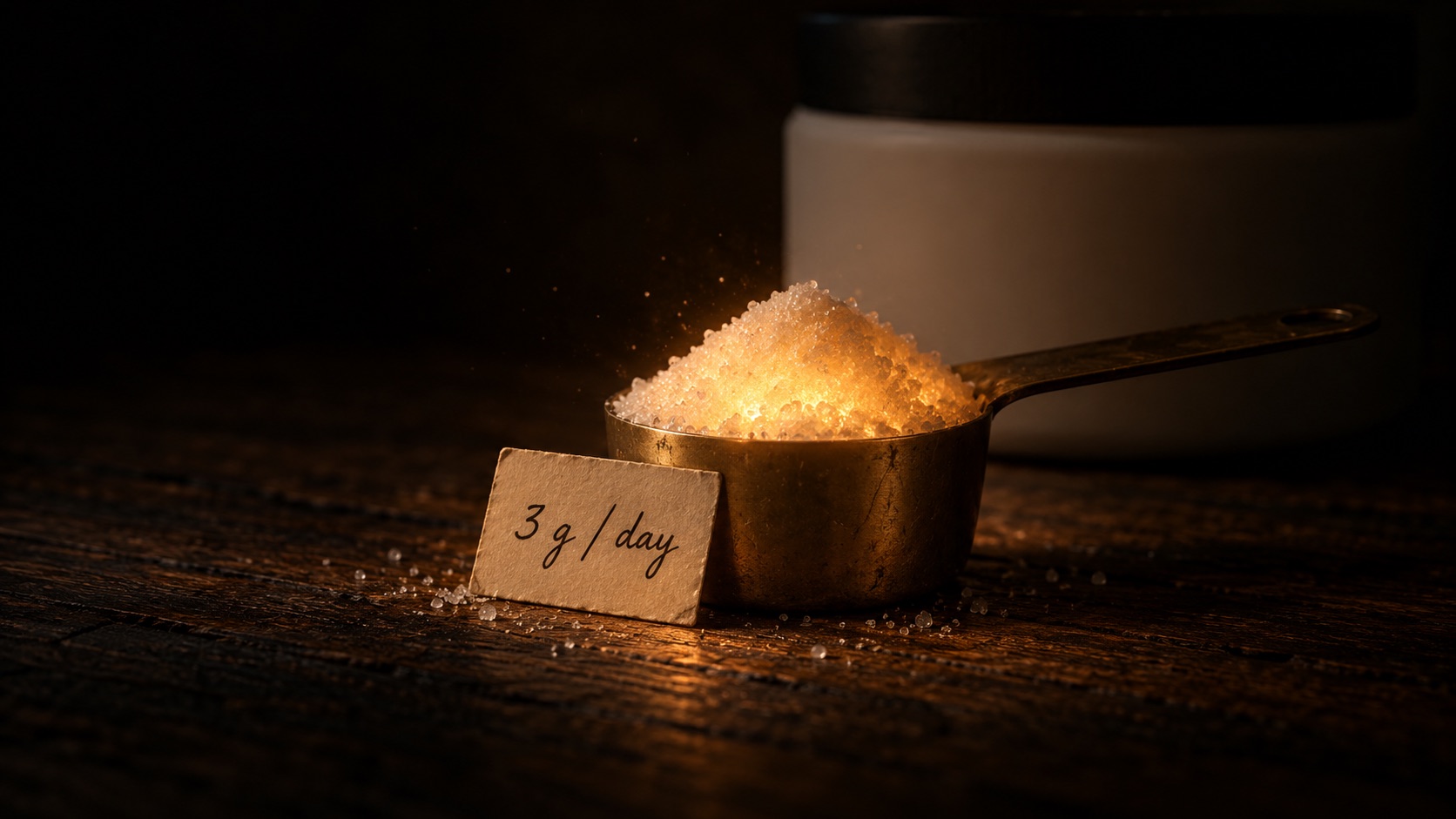
Someone at your gym swears by it. Someone else says it is basically a steroid. A third person warns it will make you puffy. Meanwhile the shelf has monohydrate, HCl, buffered and micronised versions, all promising something slightly different.
Here is the simple version. Creatine is a compound your body already makes, and it helps your muscles produce energy during short bursts of hard effort. It is not a protein. It is not a steroid. And it is one of the very few supplements where the evidence genuinely matches the hype.
This guide covers what it does, how much to take, which form to buy, and what it should actually cost you.
- ·Creatine helps your muscles recharge energy fast during heavy or explosive effort
- ·Buy creatine monohydrate, the most studied form by a wide margin
- ·Take 3 to 5 g a day, every day, at whatever time you will remember
- ·Loading is optional, it only fills your stores faster
- ·Early weight gain is water inside the muscle, not fat
- ·It costs roughly 8 to 17 rupees a day in India, so price should not be the barrier
What creatine actually is
Creatine is made in your liver and kidneys from amino acids, at roughly a gram a day. You also get some from food, mainly meat and fish. Almost all of it ends up stored in your skeletal muscle.
Your muscles do not burn creatine directly. They store most of it as phosphocreatine, and that is where the useful part happens.
How it works, in one minute
Every muscle contraction runs on ATP. Think of ATP as the cash in your pocket: it is the only currency your muscles can spend right now.
The problem is you carry very little of it. A few seconds into a heavy set, that immediate supply is largely gone. Your body has to make more, fast.
The whole mechanism, plainly
Phosphocreatine sitting in your muscle donates a phosphate group to rebuild spent ATP. More creatine stored means a bigger reserve to rebuild from, which means you recharge faster between efforts. That is the entire mechanism. No hormones involved.
This is why creatine helps most with heavy lifting, sprinting, jumping and repeated short bursts, and why it does very little for distance running. The US National Institutes of Health Office of Dietary Supplements makes the same distinction: strong support for repeated high intensity efforts, much weaker for endurance work.
Does creatine actually make you stronger?
Indirectly, yes, and the honest explanation is less exciting than the marketing.
With fuller creatine stores you might get one more rep, hold your power across more sets, or recover slightly faster between them. Small things. But do a little more quality work every session for six months and it adds up to meaningfully more training. That accumulated training is what builds strength and size.
Creatine does not replace training or food. Taking it while doing nothing demanding achieves nothing. It is a tool that helps you get more out of work you are already doing.
Is creatine a steroid?
No, and it is worth being blunt because the confusion is common.
Anabolic steroids are synthetic hormones. Creatine is a compound your body makes on its own and stores in muscle, and it works purely through the ATP energy system. The two get mentioned together only because both are associated with strength. That is where the similarity ends.
On the legal side in India, creatine is not banned and never has been. We went through what the rules actually say in is creatine banned in India.
Why the scale goes up when you start
This is the most misread thing about creatine.
As your muscle creatine stores fill, your muscles hold more water. The scale moves. That is water inside muscle tissue, not body fat, and the NIH describes exactly this pattern.
So if you gain a kilo or two in the first couple of weeks, nothing has gone wrong. Judge the change by the mirror, your lifts and your waist measurement rather than by the scale alone.
How much should you take?
Three to five grams of creatine monohydrate a day. That is it.
You may also have heard about loading: roughly 20 g a day split into smaller doses for five to seven days, then dropping to 3 to 5 g. Loading fills your muscle stores in days instead of weeks.
But loading is optional. Taking 3 to 5 g daily from the start reaches the same destination, just a few weeks later. Unless you have a competition next month, the simple route is fine.
When should you take it?
Whenever you will actually remember.
Creatine is not caffeine. There is no acute hit to time around your session. You are topping up a store inside the muscle, and that store responds to how consistently you take it, not to whether you took it 30 minutes before training. Before, after, with breakfast, in your evening tea. Pick the one you will not forget.
Which type of creatine should you buy?
Creatine monohydrate. The shelf offers HCl, buffered, ethyl ester and others, and the packaging implies monohydrate is the entry-level option they have improved on.
The evidence does not support that. Monohydrate is the most extensively studied form and remains the standard choice, and there is no strong evidence the newer forms outperform it. They are frequently more expensive, which is a different thing from being better.
A useful signal from our own catalogue
Every creatine product we currently track in India is creatine monohydrate, and every one of them is dosed at 3 g per serving. Not a single HCl or buffered version among them. When the entire market quietly converges on one form at one dose, that tells you something the labels do not.
What creatine should cost you
Creatine is remarkably cheap, and people are often surprised by how cheap once they work it out per day rather than per tub.
Two reasons. First, creatine is made by chemical synthesis rather than pulled out of milk the way whey protein is. Second, the dose is tiny. At 5 g a day you use about 150 g in a month. Protein powder users get through 25 to 50 g every single day.
Here is what a gram of actual creatine costs across the tubs we track right now. Same molecule, same 3 g dose, very different prices:
What a gram of creatine actually costs in India
Every tub below is creatine monohydrate at 3 g per serving. Same molecule, same dose. The only thing that changes is what you pay for it.
In daily terms that is roughly ₹8 to ₹17 for your creatine, depending which tub you picked. The molecule is identical in all of them, so the gap is brand, packaging and pack size. Bigger tubs are consistently cheaper per gram, which is why the same brand can appear at both ends of that chart in different sizes.
The same creatine, two tub sizes
Optimum Nutrition sells the identical micronised monohydrate in a 100 g tub and a 250 g tub. The bigger one costs more on the shelf and roughly half as much per gram. This is the clearest illustration on the whole page of why the sticker price is the wrong number to compare.
Do you still need it if you eat meat?
Not necessarily. You do get creatine from meat and fish, and your body makes its own.
But dietary amounts are far smaller than a supplemental dose, which is why supplementing raises muscle stores beyond what diet alone typically reaches. People who eat little or no meat tend to start with lower stores and can respond more noticeably. That does not mean everyone needs it. It just explains who tends to feel the biggest difference.
Is creatine safe?
For healthy adults, creatine monohydrate has one of the strongest safety records of any sports supplement, including over years of use.
Some people get mild stomach discomfort, usually at larger doses, and the water weight discussed above is normal. Still, no supplement is right for everyone. If you have a medical condition, take medication, are pregnant or breastfeeding, or are thinking about creatine for someone under 18, talk to a qualified healthcare professional first.
How to choose a tub without overthinking it
Once you know you want monohydrate, the decision gets easy. Check three things:
- The form. It should say creatine monohydrate, plainly.
- The dose. Around 3 g per serving, and how many servings the tub holds.
- The cost per gram. Price divided by total creatine, not the price on the front.
That is the whole checklist. There is very little reason to pay a premium for a tub of the same molecule because it has nicer packaging.
So which tub should you actually buy?
All five are creatine monohydrate at 3 g per serving. Nobody paid to be listed. Prices move daily, so check the live number before you buy.
You can also compare every creatine we track with live prices, or run two products head to head in the comparison tool.
The bottom line
Creatine is not a steroid, not a stimulant and not a shortcut. It is a compound your body already makes, which helps your muscles rebuild energy during short, hard efforts. Topping up those stores can improve strength, power and your ability to repeat high intensity work.
For almost everyone the answer is the same, and it is the cheap one: creatine monohydrate, 3 to 5 g a day, taken consistently. No loading protocol required, no premium version required, no perfect timing required.
Get the basics right first. Train regularly, eat enough, sleep properly. Creatine is then a genuinely simple supplement that, unlike most of the shelf, actually has the evidence behind it.
This article reflects the independent editorial opinion of the Whey2Much team. No brand paid to be included, recommended or ranked, and we do not accept payment for editorial placement. The physiology, dosing and safety points above reflect established sports nutrition evidence, including the position of the US National Institutes of Health Office of Dietary Supplements in its fact sheet on supplements for exercise and athletic performance. Prices shown are live from our own tracking and change daily. Supplement formulations, availability and claims change over time, so read the label before you buy. This is general education, not medical or nutritional advice. Creatine is not appropriate for everyone: if you have a medical condition, take medication, are pregnant or breastfeeding, or are considering supplementation for someone under 18, speak to a qualified healthcare professional first. Supplements complement a balanced diet and sensible training rather than replace them.
Common questions
Creatine is a compound your body makes naturally from amino acids and stores mostly in your muscles. It helps regenerate ATP, the immediate energy your muscles use during short bursts of hard effort. Your liver and kidneys produce roughly one gram a day, and you get more from meat and fish.
No. Creatine is not an anabolic steroid. It is a naturally occurring compound your body already produces, and it works through the energy system that recharges ATP rather than by acting like testosterone or any other hormone.
Three to five grams of creatine monohydrate a day is the commonly used maintenance dose for healthy adults. Consistency matters far more than the exact number inside that range.
No. Loading, usually around 20 grams a day split into smaller doses for five to seven days, fills your muscle stores faster. Taking three to five grams daily reaches the same place, it just takes a few weeks instead of a few days. Most people can skip loading entirely.
It can raise the number on the scale, but that is mostly water held inside the muscle rather than body fat. Creatine draws water into muscle tissue as your stores fill up, so a small early weight increase is normal and is not fat gain.
Whenever you will remember it. Creatine is not a stimulant like caffeine, so there is no acute pre-workout effect to time. The goal is to keep your muscle stores topped up, which depends on taking it every day rather than on taking it at a particular hour.
Creatine monohydrate. It is by far the most studied form and remains the standard recommendation. Newer forms such as HCl, buffered creatine and ethyl ester usually cost more without strong evidence that they work better. Every creatine product we track in India is monohydrate.
Far less than most people expect. Across the creatine we track, a three gram daily dose currently works out between about eight and seventeen rupees a day, depending which tub you buy. Since every product is the same molecule at the same dose, that gap is packaging, brand and pack size rather than quality.
Creatine monohydrate has one of the longest safety records of any sports supplement in healthy adults, including long term use. Some people get mild stomach discomfort, especially at larger doses. It is not right for everyone, so speak to a qualified healthcare professional if you have a medical condition, take medication, are pregnant or breastfeeding, or are considering it for someone under 18.

Written by
Whey2Much
India's smartest supplement price comparison platform. We track real-time prices across the country's top retailers so you never overpay.
Keep reading
More from the journal.

Creatine for Women: The Supplement Indian Gyms Got Wrong
Creatine does not make women bulky. The real mechanism, the 3 to 5 g dose, what it costs per day in India, and what the scale actually does by week 8.

Protein for Weight Loss: How Much, and Which Kind
Protein is the satiety lever, not a fat burner. The gram target, the deficit maths, and which Indian tubs are genuinely low carb, checked against real panels.

How to Hit 100g of Protein a Day on Indian Vegetarian Food
A real Indian vegetarian day that hits 101 g of protein, with grams and rupees on every item, plus the honest line on where a scoop actually helps.