
Creatine for Women: The Supplement Indian Gyms Got Wrong
The bulky fear comes down to about 1 to 2 kg of water, and it sits inside the muscle rather than under your skin. Here is the mechanism, the dose, what it costs a day in India, and what the scale actually does.


Creatine will not make you bulky. The 1 to 2 kg you might see on the scale in your first fortnight is water sitting inside the muscle, not fat under your skin, and it drains away within 4 to 6 weeks if you stop.
That single sentence is the reason most Indian women who would benefit from creatine never take it. So here is the mechanism properly, the dose, what it costs a day, and what the scale actually does week by week.
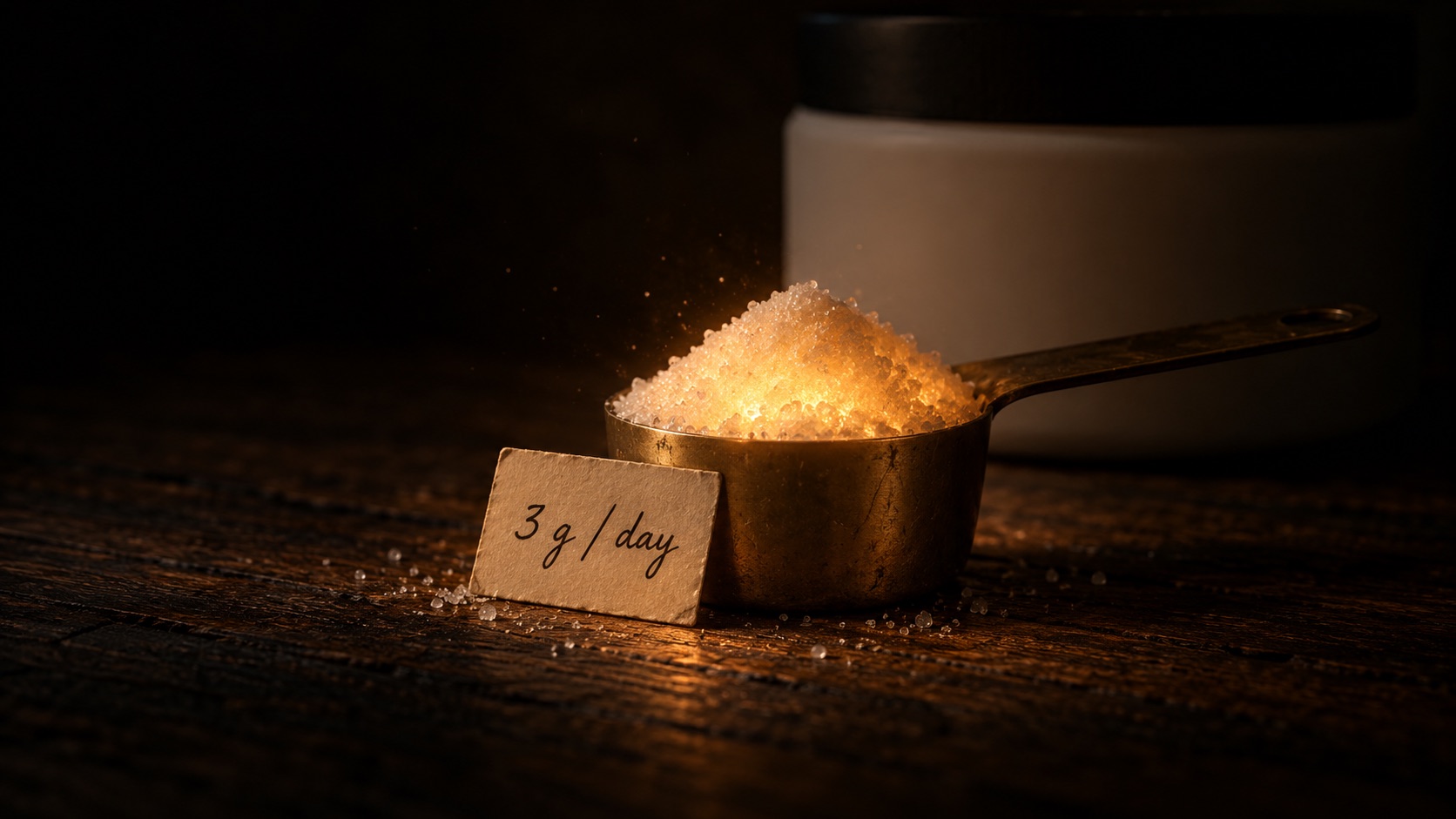
- ·The dose is the same as for men: 3 to 5 g a day of creatine monohydrate
- ·There is no women’s formula worth paying extra for. Every tub we track is monohydrate
- ·Early weight gain is water inside the muscle, about 1 to 2 kg, and it reverses if you stop
- ·Women carry substantially lower natural creatine stores than men
- ·It costs 6.67 to 17.11 rupees a day across the 12 tubs we track
- ·Creatine supports training. Training is what changes how you look
Does it work the same way in a woman's body?
The mechanism is identical. Creatine is stored in muscle as phosphocreatine, which helps rebuild ATP during short bursts of hard effort. More stored creatine means a bigger reserve to draw on, which means you can do a little more work in the sets that matter. Over months, more work is more progress.
The interesting difference is the starting point. A 2021 review in Nutrients looking at creatine across the female lifespan reports that women carry substantially lower natural creatine stores than men, and that hormonal changes affect creatine metabolism at several points in life.
Starting lower does not automatically mean gaining more, and the review is careful about that. But it does undercut the idea that creatine is a male supplement. If anything, women have more room in the tank.
Will it make you bulky or puffy?
No, and the mechanism explains why cleanly.
Creatine is stored in muscle cells, and it pulls water in with it. That water is intracellular, meaning inside the muscle, rather than subcutaneous, meaning under the skin. Subcutaneous water is what people mean by puffy. Intracellular water makes muscle slightly fuller, which most people find they like once they see it.
The amount is roughly 1 to 2 kg, it arrives in the first couple of weeks, and it goes away over 4 to 6 weeks if you stop taking it.
Why bulky is the wrong worry
Building visibly larger muscle takes months of progressive training and enough protein, and it is difficult on purpose. Creatine helps you train slightly harder. It does not add muscle on its own, and nothing about it makes that process faster than a woman can notice and adjust. If you find you are gaining size you did not want, you would change your training long before the supplement became the issue.
What the scale does, week by week
| When | What the scale shows | What it actually is |
|---|---|---|
| Week 1 to 2 | Up 1 to 2 kg | Water moving into muscle as stores fill. Not fat |
| Week 3 to 4 | Steady | Stores are full. The scale stops moving from creatine |
| Week 5 to 8 | Depends on your training and eating | Anything now is your diet and training, not the creatine |
| If you stop | Down 1 to 2 kg over 4 to 6 weeks | The same water leaving. You have not lost muscle |
Knowing this in advance is most of the battle. A lot of women start creatine, see the scale move up in week two, decide it is making them gain weight and stop, which is exactly the wrong conclusion from exactly the right observation.
If the scale bothers you, use a tape measure and how your clothes fit instead for the first month.
Does being vegetarian change anything?
It might make it more noticeable. Dietary creatine comes mainly from meat and fish, so a vegetarian starts with lower muscle stores than an omnivore eating the same amount of food.
That means more room to fill, and some research suggests vegetarians respond more clearly to supplementation. Given how many Indian women are vegetarian, this is a relevant point that rarely gets made.
On suitability: creatine monohydrate is produced synthetically rather than extracted from animals, so the powder itself is generally suitable for vegetarians. Check the individual product for other ingredients, and for capsules check the shell.
Strength, bone and the years around menopause
This is where the conversation has moved in the last two years, and it is worth being precise because the claims get stretched.
The 2021 Nutrients review notes that creatine may be particularly relevant at several points in the female lifespan, and that post-menopausal women may see benefits in skeletal muscle size and function, with favourable effects on bone when creatine is combined with resistance training.
Two qualifiers that matter. The muscle findings it describes in post-menopausal women used high doses, around 0.3 g per kg of body weight a day, which for a 60 kg woman is about 18 g rather than the usual 3 to 5. And the bone effects are tied to doing the resistance training, not to the powder by itself.
So the honest version is this: creatine looks promising in midlife, the strongest signal comes alongside lifting, and some of the research uses doses well above what a standard tub suggests. If you are in perimenopause or past menopause and considering it, that is a good conversation to have with your doctor rather than a reason to take an article's word for it.
Periods and PCOS
Periods. There is no established reason to stop or cycle creatine around your period. It works by keeping stores topped up, so daily consistency is the whole point.
PCOS. The research on creatine specifically in PCOS is early and small, and nobody should be selling it as a PCOS treatment. What is defensible: creatine supports strength training, and strength training is well established as useful for insulin sensitivity and body composition. That is an indirect argument, and it is the only one currently available.
PCOS care is individual and often involves medication. Please set your plan with your own doctor.
Safety, and the blood test trap
Creatine monohydrate has one of the longest safety records of any sports supplement in healthy adults, and the International Society of Sports Nutrition position stand describes 3 to 5 g a day as the standard maintenance dose.
One thing to know before a routine blood test. Creatine breaks down into creatinine, the marker used to estimate kidney function. So taking creatine can raise that reading while your kidneys are entirely normal. Tell whoever orders the test that you take it, because a result read without that context gets read wrong. More in whether supplements damage your kidneys.
On hair, no study has found creatine causing hair loss, and the only trial that measured hair directly found no difference against placebo. Details in does creatine cause hair loss. Both studies were in men, so the direct evidence in women is thinner, which is worth saying plainly.
- ·You are pregnant, trying to conceive or breastfeeding
- ·You have kidney disease, or reduced kidney function
- ·You have PCOS, thyroid disease or any condition managed with medication
- ·You have a history of disordered eating, where scale changes can be difficult
- ·You are under 18, or considering it for someone who is
- ·You are already being treated for hair loss
How much to take
Three to five grams a day of creatine monohydrate, every day, at whatever time you will remember. It is not a stimulant, so there is no pre workout timing effect to chase.
Loading is optional. Taking 20 g a day for a week fills your stores faster, and taking 3 to 5 g daily gets to the same place in a few weeks. Most people should skip it, and for anyone worried about the scale, skipping loading also makes the early water gain gentler.
Every creatine product we track in India is monohydrate at around 3 g per serving, which makes the shelf simpler than it looks. There is no women's creatine worth paying for.
What it costs a day in India
Across the twelve tubs we track, a 3 g daily dose costs between 6.67 and 17.11 rupees. Over a year that is roughly 2,435 against 6,245 rupees for the identical molecule.
What a gram of creatine actually costs in India
Every tub below is creatine monohydrate at 3 g per serving. Same molecule, same dose. The only thing that changes is what you pay for it.
Since the powder is the same, the ranking is purely price, and pack size drives most of it: a 250 g tub averages about 37 percent less per gram than a 100 g one. The full ranking is in best creatine in India, ranked by cost per dose, and you can see every creatine we track, with live prices.
If you can only afford one
Protein first, if your daily protein is low. Protein is a nutrient you actually need, and most Indian women eating a typical vegetarian diet are well short of a sensible target. Our best protein powder for women in India covers that side.
If your protein is already fine, creatine is the better value addition. A daily dose at the cheap end costs less than 7 rupees, against a median whey serving at about 156. Very little in the supplement aisle offers that ratio of evidence to cost.
Checking a tub before you buy
The same checks as any supplement. Confirm the label says creatine monohydrate rather than a blend, check the FSSAI licence number, check the seal, and work out the cost per gram before you pay.
The licence lookup is in what an FSSAI licence actually proves, and the checks worth running before you buy a tub covers the rest. If you saw the reels claiming creatine had been banned in India, creatine is not banned in India has the actual position.
The bottom line
Creatine is not a men's supplement, there is no women's version worth paying for, and the bulky fear is about 1 to 2 kg of water sitting inside your muscles.
Three to five grams of monohydrate a day, taken consistently, for under 7 rupees if you buy sensibly. Expect the scale to move in week two and then stop. Judge it on how your training feels by week eight, not on the number in week two.
And if you are in perimenopause or past it, the research is genuinely interesting, the strongest signal comes alongside resistance training, and it is worth a conversation with your doctor rather than a decision made from a feed.
This article is general health information and is not medical advice, a diagnosis or a treatment plan. It has not been written or reviewed by a medical practitioner. Do not start, stop or change any supplement or prescribed treatment on the basis of it, and speak to a qualified healthcare professional if any of the situations listed above apply to you. Creatine is not presented here as a treatment for PCOS, for bone loss or for any medical condition. The lifespan, lower baseline stores and post-menopausal points draw on Smith-Ryan and colleagues, Creatine Supplementation in Women's Health: A Lifespan Perspective, published in Nutrients in 2021, which describes muscle findings in post-menopausal women at high doses of around 0.3 g per kg per day and bone effects in combination with resistance training, both of which are stated in the text above. Dosing and safety points draw on the International Society of Sports Nutrition position stand on creatine supplementation. The hair loss evidence is the 2009 Clinical Journal of Sport Medicine study of 20 male rugby players and the 2025 randomised controlled trial of 45 men published in the Journal of the International Society of Sports Nutrition, both conducted in men. Prices are from our live tracking across 19 Indian retailers, checked on 16 September 2026. Whey2Much sells nothing, takes no commission and accepts no payment from any brand or retailer for inclusion, ranking or placement.
Common questions
No. Creatine draws water into muscle cells, which can show as 1 to 2 kg on the scale in the first couple of weeks. That water sits inside the muscle rather than under the skin, and it reverses over 4 to 6 weeks if you stop. Building visible muscle takes months of progressive training and enough protein, and creatine helps that process rather than causing size on its own.
The water creatine holds is intracellular, meaning inside muscle cells, rather than the subcutaneous water associated with a puffy appearance. Facial puffiness has other common causes including salt, sleep, alcohol and hormonal changes across the cycle. If puffiness is new and persistent, that is worth a word with a doctor rather than blaming a supplement.
The same as anyone: 3 to 5 g a day of creatine monohydrate, taken consistently. There is no separate women’s dose and no need for a product marketed at women. Every creatine product we track in India is monohydrate at around 3 g per serving.
There is no evidence that it does. The hair loss concern comes from a 2009 study in 20 male rugby players that measured hormones and never examined hair, and a 2025 trial that did measure hair found no difference against placebo. Both studies were in men, so the direct evidence in women is thinner still. Hair loss in women has common causes worth investigating, including iron deficiency and thyroid problems.
There is no reason to stop. Creatine works by keeping muscle stores topped up, so daily consistency is the point, and there is no established reason to cycle around your period. Some reviews suggest creatine may be particularly relevant at points in the lifespan where hormones affect creatine metabolism, but that is a reason to keep taking it rather than to pause.
The research on creatine specifically in PCOS is early and limited, and nobody should present it as a PCOS treatment. What is reasonable to say is that creatine supports strength training, and strength training is well established as useful for insulin sensitivity and body composition. If you have PCOS, discuss supplements with the doctor managing your care.
Creatine monohydrate has a long safety record in healthy adults. It does raise serum creatinine, because creatine breaks down into creatinine, which can make a blood test look worse while kidney function is normal. Tell whoever orders the test that you take it. If you have kidney disease, ask your doctor before starting.
Protein first, if your daily protein intake is low, because protein is a nutrient you need and creatine is a performance aid. If your protein is already adequate, creatine is the better value addition: a daily dose costs between 6.67 and 17.11 rupees across the tubs we track, which is less than most whey servings.
Creatine monohydrate is produced synthetically rather than from animal sources, so it is suitable for vegetarians, though it is worth checking the individual product for any non vegetarian ingredients or capsule material. Vegetarians may also notice more from it, since dietary creatine comes mainly from meat and fish and vegetarians typically start with lower muscle stores.

Written by
Whey2Much
India's smartest supplement price comparison platform. We track real-time prices across the country's top retailers so you never overpay.
Keep reading
More from the journal.

Does Creatine Cause Hair Loss? What the Evidence Actually Shows
One 2009 study of 20 rugby players started the creatine hair loss scare, and it never measured hair. A 2025 trial did. Here is what both actually found.
What Is Creatine? A Simple Guide to How It Works and How to Take It
What creatine is, how it works, how much to take and which form to buy. A plain guide to one of the few supplements with real evidence behind it, with live Indian prices.

Is Your Whey Protein Causing Your Acne?
Whey acne is real for some and not for most. How to tell which one you are in four weeks, what the evidence actually shows, and what to switch to if you need to.