
Is Creatine Banned in India? What FSSAI Actually Says (2026)
A wave of reels announced that FSSAI had banned creatine. We went looking for the order everyone was citing. Here is exactly what we found, what is genuinely changing, and what it means for the tub on your shelf.

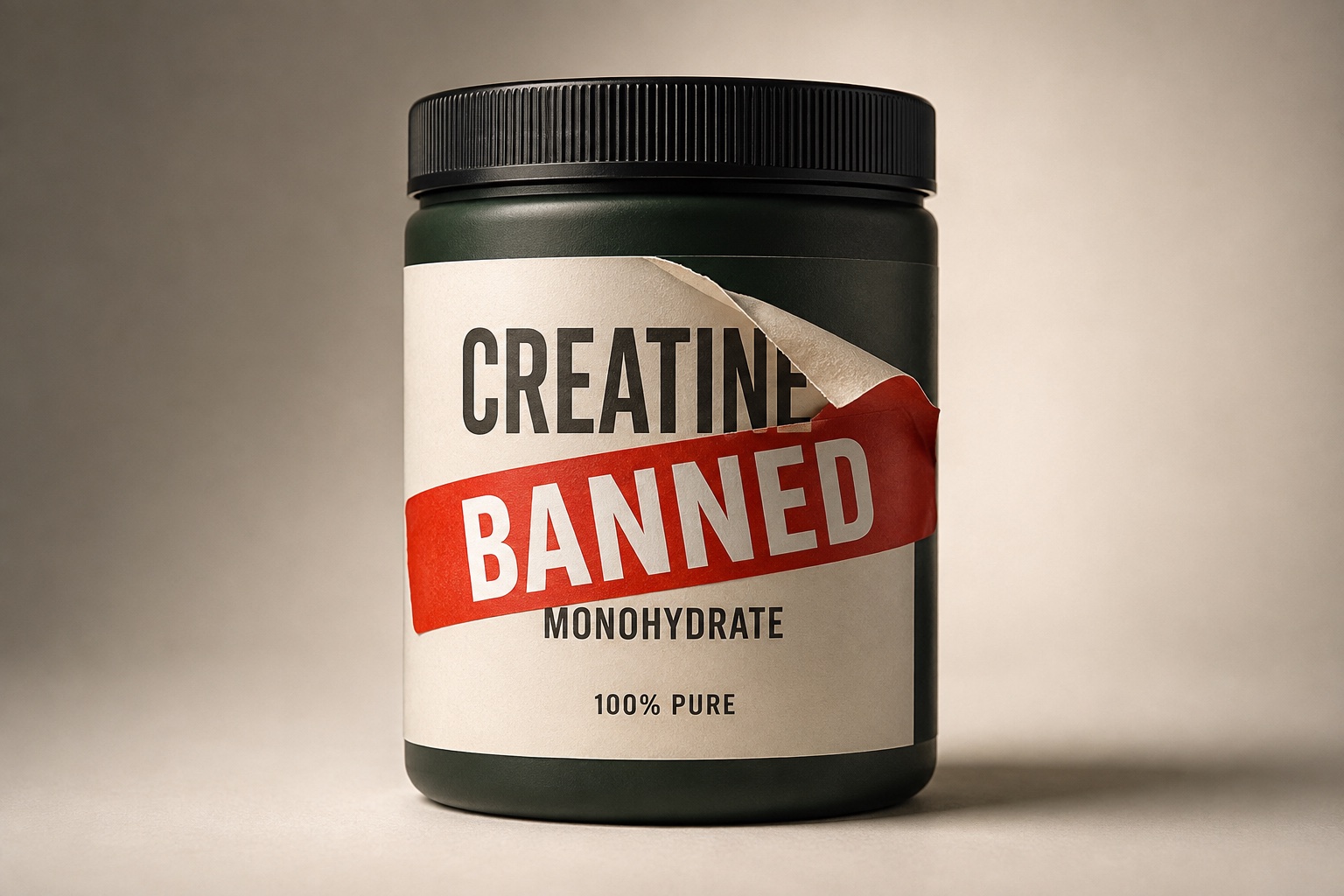
If you searched this at 1am after a reel with a siren emoji told you the government had banned creatine, you are in the right place. Short version: you are not doing anything illegal, and the tub on your shelf did not become contraband overnight.
But we did not want to just say “relax, it is fine” like everyone else. So we went and checked. Here is what we looked for, what we found, and the one part of this story that genuinely does affect what you pay.
Creatine is not banned in India. It is legal to buy, own and take. It is not a steroid, not a controlled substance, and not on any anti-doping list. We searched FSSAI's published list of ingredients that businesses must stop using, and creatine is not on it. What is real is an unfinished argument about how supplements should be regulated, and that argument got compressed into a scary sentence that travelled much further than the facts did.
What we actually checked
The claim doing the rounds was specific: that FSSAI had banned creatine “as a single isolated synthesised ingredient,” forcing brands to add a second ingredient so the product counts as a blend. That is a precise enough claim to be checkable, so we tried to check it.
What we looked for, and what we found
One honest caveat about our own method: several of FSSAI's document links return an empty page rather than the file, so parts of the primary record are genuinely hard for anyone to pull up. That difficulty is a large part of why rumours like this spread unchecked.
None of that proves a negative with total certainty. What it does show is that nobody amplifying the ban claim was showing their working, and when we went looking for the document they were all gesturing at, it was not there.
What a real FSSAI ban actually looks like
This is worth understanding, because it gives you a standard to hold any future claim to, including ours.
When FSSAI genuinely pulls an ingredient, it issues a direction that names it. It has done exactly that: food businesses were told to stop using a specific set of ingredients that lacked adequate safety data. The list includes raspberry ketone, silica, angelica sinensis, paullinia cupana, saw palmetto, notoginseng, chlorella growth factor, two pine bark extracts, chaga extract, oxalobacter formigenes, phytavail iron and tea tree oil.
Named. Dated. Published. That is what a ban looks like. Creatine is not on that list, and there is no equivalent order for it.
If someone tells you an ingredient is banned and cannot point you to the order that names it, they are describing a rumour, not a regulation.
So where did the smoke come from?
Two real things happened, and both are easy to garble into “creatine is banned.”
1. A genuine crackdown, on unlicensed sellers, in 2018
Back in March 2018, state food safety authorities moved against the unlicensed manufacture, import and sale of creatine monohydrate. Read quickly, that becomes “authorities crack down on creatine.” Read properly, it is the opposite of a ban: it is the regulator enforcing that creatine must be sold through licensed businesses. The product was never the problem. The paperwork was.
2. An unresolved fight about who regulates supplements
Since 2024, an inter-ministerial committee including the heads of both FSSAI and CDSCO has been reviewing whether supplements should stay entirely with the food regulator or whether higher-potency products and anything making disease claims should fall under the drug regulator's stricter oversight. Amino acids were among the categories discussed. Industry bodies pushed back hard and asked for the proposal to be paused.
That argument is real, unfinished, and genuinely worth following. But notice what it is: a question about jurisdiction, not a ban on a molecule. Somewhere in the retelling, “supplements might move to the drug regulator” became “supplements are being banned.” Those are very different sentences.
Separately, FSSAI has signalled it is preparing tighter rules for protein supplements after finding widespread misleading claims. We covered how that machinery actually works in what “FSSAI approved” actually means, which is worth reading if you have ever assumed that stamp was a lab test. It is not.
Is creatine banned for athletes?
No, and this one is the easiest claim on the whole list to verify. Creatine does not appear on the World Anti-Doping Agency prohibited list, and India's National Anti-Doping Agency follows WADA. Competitive lifters, cricketers and anyone subject to testing can use it without it being a doping violation.
The gym-floor line that creatine is “basically steroids” has never been true. Creatine is a compound your body already makes in the liver and kidneys, and that you get from red meat and fish. A steroid is a hormone. They are not related in any way that matters.
If you are vegetarian, this cuts the other way and it is genuinely useful: dietary creatine comes almost entirely from meat and fish, so vegetarians typically start with lower muscle creatine stores. Supplementation often does more for them than for heavy meat eaters.
The part that should actually concern you
Here is where we stop reassuring you and start being useful.
The realistic risk in this story is not that creatine disappears from shelves. It is formulation drift. If regulatory pressure nudges brands toward selling creatine inside a formulated blend rather than as a plain single ingredient, some tubs quietly stop being creatine monohydrate and start being creatine plus something else. A blend. A “matrix.” An added electrolyte or amino acid.
And added ingredients are how brands add price. A blend gives marketing something to talk about, and it gives the label a reason to cost more per gram of the thing you actually came for. Plain creatine monohydrate is one of the cheapest effective supplements in existence, and it is exactly the kind of product that gets quietly upgraded into something pricier that does the same job.
Which brings us to the number nobody in this conversation is showing you.
What a gram of creatine actually costs in India
Every tub below is creatine monohydrate at 3 g per serving. Same molecule, same dose. The only thing that changes is what you pay for it.
Every product in that chart is creatine monohydrate at three grams per serving. Identical molecule, identical dose. The gap between the cheapest and the priciest is not a difference in what you are getting. It is a difference in what you are paying.
Look closer and it gets sharper: the same brand can sell you the same creatine at wildly different value depending only on tub size. Buying a small tub instead of the large one of the identical product can cost you more than double per gram. That is the real money leak in this category, and no reel is shouting about it.
Five checks before you buy any creatine
- 1Find the 14 digit FSSAI licence number on the pack and look it up on the FoSCoS portal. No number is an immediate red flag.
- 2Read the ingredient list. Good creatine has one ingredient: creatine monohydrate. A long list means you are paying for something other than creatine.
- 3Prefer plain monohydrate. It is the most researched form, the most proven, and almost always the cheapest. Fancier forms consistently fail to beat it in studies.
- 4Do the per gram maths, not the sticker price. Divide the price by grams of actual creatine in the tub. Bigger tubs usually win, sometimes by more than double.
- 5Be suspicious of impossible prices. Genuinely cheap can be genuine. Far below every other seller for the same weight means the gap is coming from somewhere.
The best value creatine we track right now
All three below are plain creatine monohydrate at three grams per serving. Prices update daily, so check before you buy.
The large unflavoured tub from a globally established brand, and currently the cheapest actual creatine per gram in our catalogue. Worth noting that the 100 g version of this very same product costs well over double per gram.
A sensible entry point if you do not want to commit to a big tub on your first purchase. Unflavoured, single ingredient, and priced far more honestly than most small packs.
Another large plain monohydrate tub with excellent per gram value, useful if the pick above is out of stock at your preferred retailer.
You can put any two of these head to head, including on cost per gram of creatine, with our comparison tool, or see every creatine we track with live prices on the creatine page.
The bottom line
Creatine is not banned in India. There is a real and unfinished conversation about how supplements should be regulated, and it is worth following. But it got compressed into a frightening sentence, and the frightening sentence travelled a great deal further than the facts did.
This is a pattern you will keep seeing, because in supplements, confusion is profitable. Panic makes people buy, switch or stockpile, and very few of the voices explaining the news to you are neutral about what you buy next.
We do not sell supplements. We compare what they cost and check what is actually in them, and we do not take money from brands to say nice things. So when we tell you something is fine, there is nothing in it for us.
Check the licence number. Check the ingredient list. Check what you are paying per gram. That was the whole game before this news, and it still is.
This article is for general information and reflects publicly available regulations and reporting as understood at the time of writing. It is not medical, legal or regulatory advice. Regulations, ingredient lists and enforcement practices change, and our checks of the public record cannot rule out documents we were unable to access. Always read the label, verify the FSSAI licence yourself, and consult a qualified healthcare professional if you have a medical condition or any concern about supplementing. Whey2Much is not affiliated with FSSAI, WADA or NADA, and does not manufacture or sell supplements.
Common questions
No. Creatine is legal to buy, own and take in India. We checked FSSAI’s published direction listing ingredients that food businesses must stop using, and creatine does not appear on it. We also could not find any published FSSAI notification banning creatine as a standalone ingredient. What does exist is an unresolved policy debate about how supplements should be regulated, which is a very different thing from a ban.
We could not verify that claim against any published FSSAI notification. The claim spread through creator videos and social posts, each largely citing the one before it rather than a source document. FSSAI publishes its ingredient directions by name, so a genuine ban on creatine would appear in a numbered, dated order. We found no such order.
No. Creatine is a compound your own body produces in the liver and kidneys, and that you also get from red meat and fish. Steroids are hormones. They are unrelated, and creatine has never been classed as a controlled substance in India.
No. Creatine is not on the World Anti-Doping Agency prohibited list, and India’s National Anti-Doping Agency follows the WADA list. Competitive athletes in India can use creatine without it being a doping violation.
FSSAI directed food businesses to stop using a specific set of ingredients that lacked sufficient safety data, including raspberry ketone, silica, angelica sinensis, paullinia cupana, saw palmetto, notoginseng, chlorella growth factor, pine bark extracts, chaga extract, oxalobacter formigenes, phytavail iron and tea tree oil. Creatine is not among them.
FSSAI does not approve individual products the way people assume. It licenses the businesses that manufacture and sell supplements, and it regulates which ingredients may be used and what claims may be made. So the right thing to check is that the product carries a valid 14 digit FSSAI licence number, which you can verify on the FoSCoS portal.
Nothing we found gives a healthy adult a reason to stop. Creatine monohydrate remains one of the most studied supplements in existence. The more useful response is to check your specific product’s licence number and ingredient list, and to check what you are paying per gram, since that is where buyers actually lose money.
Creatine monohydrate has a long safety record in healthy adults at standard doses of three to five grams a day, and it is among the most heavily researched supplements available. If you have an existing kidney condition or any other medical concern, speak to a doctor rather than to the internet.

Written by
Whey2Much
India's smartest supplement price comparison platform. We track real-time prices across the country's top retailers so you never overpay.
Keep reading
More from the journal.
What Is Creatine? A Simple Guide to How It Works and How to Take It
What creatine is, how it works, how much to take and which form to buy. A plain guide to one of the few supplements with real evidence behind it, with live Indian prices.

Creatine for Women: The Supplement Indian Gyms Got Wrong
Creatine does not make women bulky. The real mechanism, the 3 to 5 g dose, what it costs per day in India, and what the scale actually does by week 8.
What Does 'FSSAI Approved' Actually Mean on Your Protein Powder?
FSSAI approved does not mean lab tested or protein verified. Here is what an FSSAI licence actually certifies on Indian supplements, and how to check one yourself.